
Last updated September 10, 2026
Full 25-point door and opener safety check with every visit - springs, cables, rollers, tracks, and your LiftMaster or Chamberlain opener included
You get a price before we start. It does not change when the truck arrives.

 Before
 After
After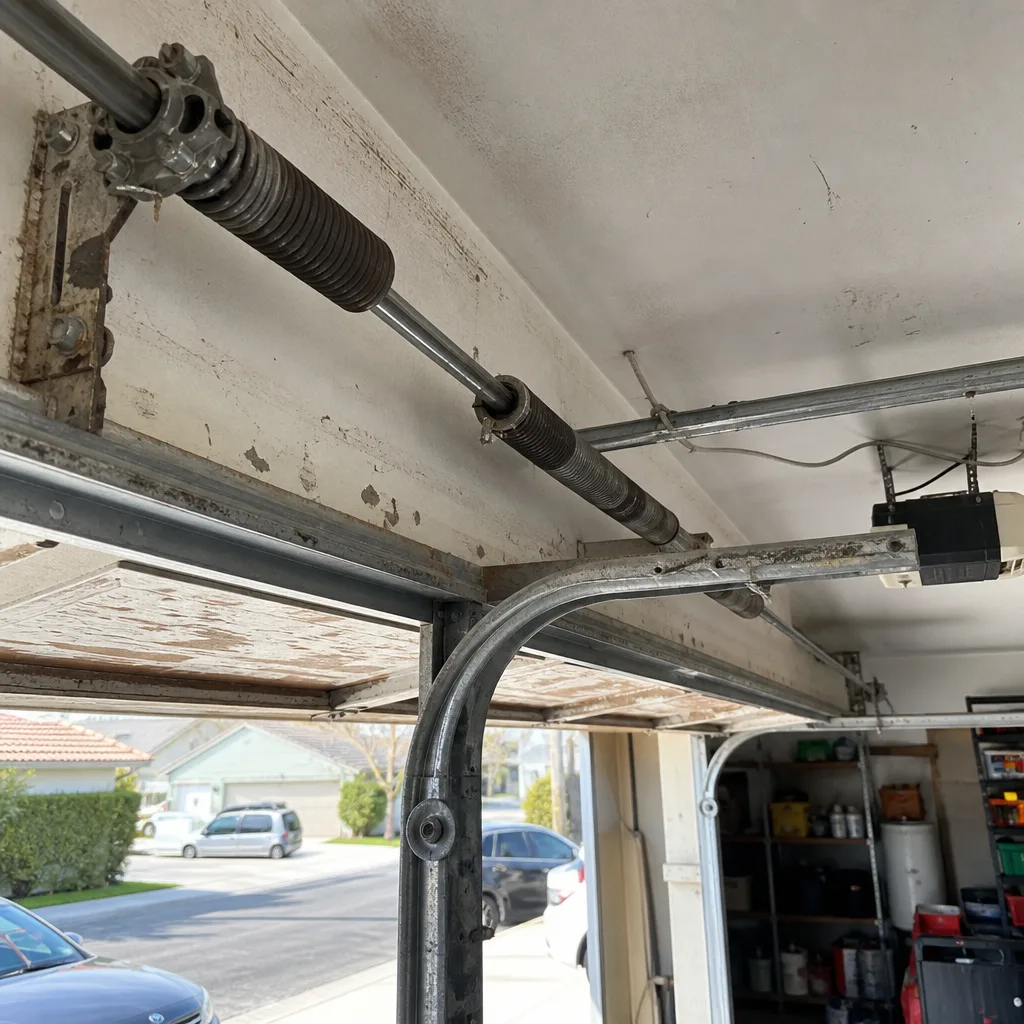 Before
 After
After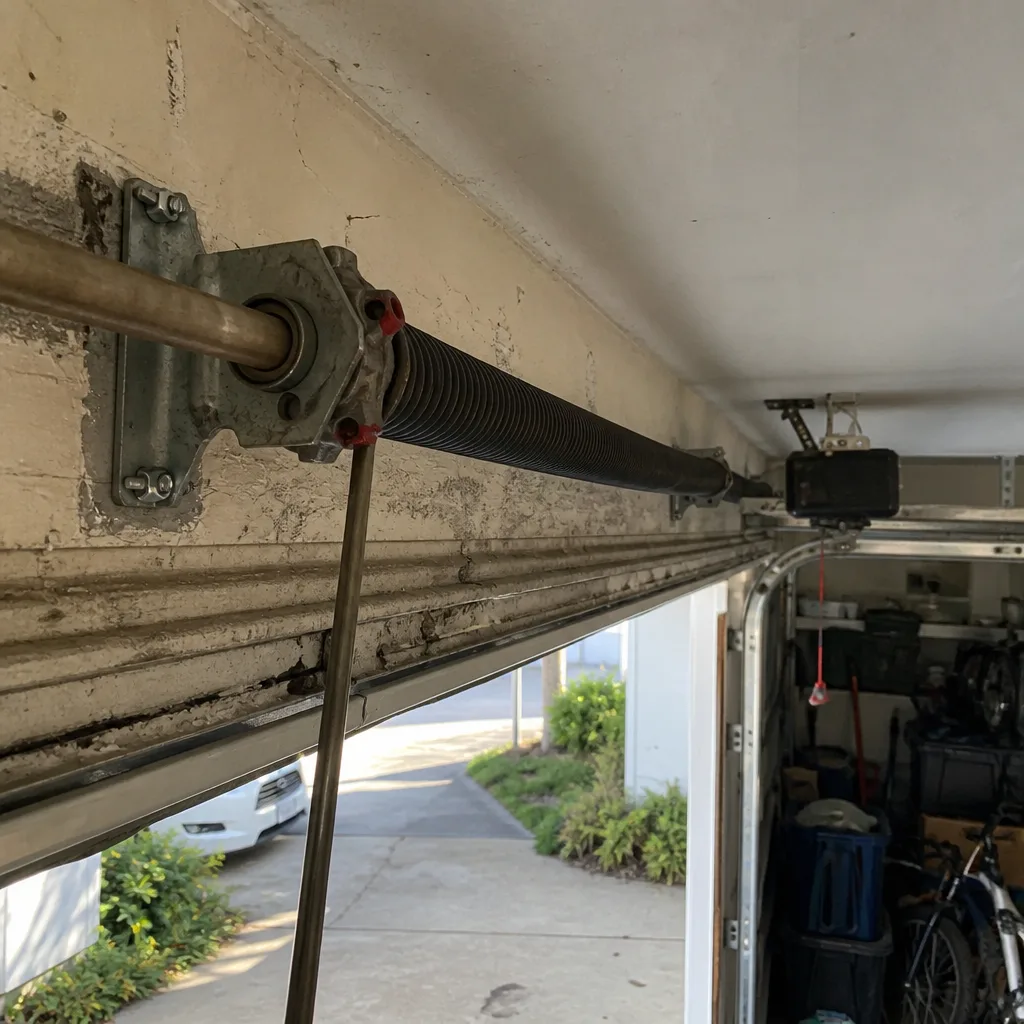 Before
 After
AfterSeasonal Garage Door Care for Newport Beach: Year-Round Homeowner’s Guide
The marine layer that keeps Newport Beach mild in June and July is also silently depositing salt particulate on every exposed metal component on your garage door - and it does its worst work during the weeks you’re least likely to notice anything wrong. Most homeowners here think seasonal maintenance means waiting for something to break. After 42 years of service calls across Corona del Mar, Balboa Peninsula, and the Newport Coast, we’ve learned that Newport Beach doesn’t follow a textbook seasonal calendar. It follows four distinct stress windows that punish specific garage door components in predictable ways. This guide maps those windows to the exact inspections and adjustments that prevent the expensive repairs we get called out for every year. For The Complete Guide to Garage Door in Newport Beach and more guides & resources, visit our blog.
Quick Answer
Garage door seasonal maintenance in Newport Beach should follow four local stress windows, not a generic calendar: June Gloom marine layer deposits (salt corrosion inspection), late-August through September heat peak (spring tension and lubrication check), October through January Santa Ana wind season (track alignment and seal inspection), and February through April winter rain period (bottom seal and drainage verification). A professional tune-up at the start of each window costs $89 and prevents the $250-$600 repair calls that peak in the weeks after each stress period ends. See our Garage Door Cost Breakdown: The Newport Beach Homeowner’s Reference for 2026 for detailed pricing.
Table of Contents
- The Four Newport Beach Stress Windows
- June Gloom: Salt Deposit Period
- Late-Summer Heat Peak: Spring Tension Drift
- Santa Ana Wind Season: Mechanical Overwork
- Winter Rain Intrusion: Seal and Drainage
- UV Damage at Newport Beach Latitude
- The One Annual Task Most Checklists Omit
- What You Can Check vs. What Requires a Pro
- Common Mistakes to Avoid
- When to Call a Professional
- Frequently Asked Questions
- The Bottom Line
The Four Newport Beach Stress Windows
Newport Beach sits at 33.6 degrees north latitude with a coastal Mediterranean climate moderated by the Pacific Ocean. That moderation creates a false sense of security. The temperature swing between our coolest winter morning and our hottest September afternoon is only about 25 degrees Fahrenheit. But the specific mechanisms of heat, humidity, salt, and wind here create concentrated damage in predictable months.
We’ve tracked our service call data across four decades. The pattern is consistent. Calls spike in mid-July (after June Gloom has done its work), late September (after the heat peak), mid-January (after Santa Ana winds), and late April (after winter rains). Each spike represents homeowners who could have caught the problem eight weeks earlier for the cost of a tune-up.
The four stress windows:
- June Gloom (May 15 - July 15): Marine layer humidity with salt particulate deposition on all exposed metal
- Late-Summer Heat Peak (August 15 - September 30): Maximum ambient temperature plus thermal mass heating of steel components
- Santa Ana Wind Season (October 15 - January 15): Sustained high-velocity dry winds with dust and debris loading
- Winter Rain Intrusion (February 1 - April 15): Pacific storm systems with wind-driven water at the door perimeter
Each window demands a different inspection protocol. The sections below detail what to check, what you’re looking for, and when the inspection is most effective.
June Gloom: Salt Deposit Period
The marine layer in Newport Beach isn’t just fog. It’s a saturated air mass carrying dissolved ocean salts that settle on every horizontal and exposed vertical surface. Your garage door’s top rail, the exposed portion of torsion springs, and the chain or belt of your opener are all collection points. The salt doesn’t cause immediate failure. It initiates galvanic corrosion that accelerates once the late-summer heat arrives.
In the harbor-adjacent neighborhoods of Lido Isle and Balboa Island, we’ve measured corrosion rates on unprotected steel hardware at roughly 1.5 times the rate seen inland in Newport Coast. The difference is the salt load in the air, which increases measurably within a quarter-mile of open water.
What to Inspect in Early June
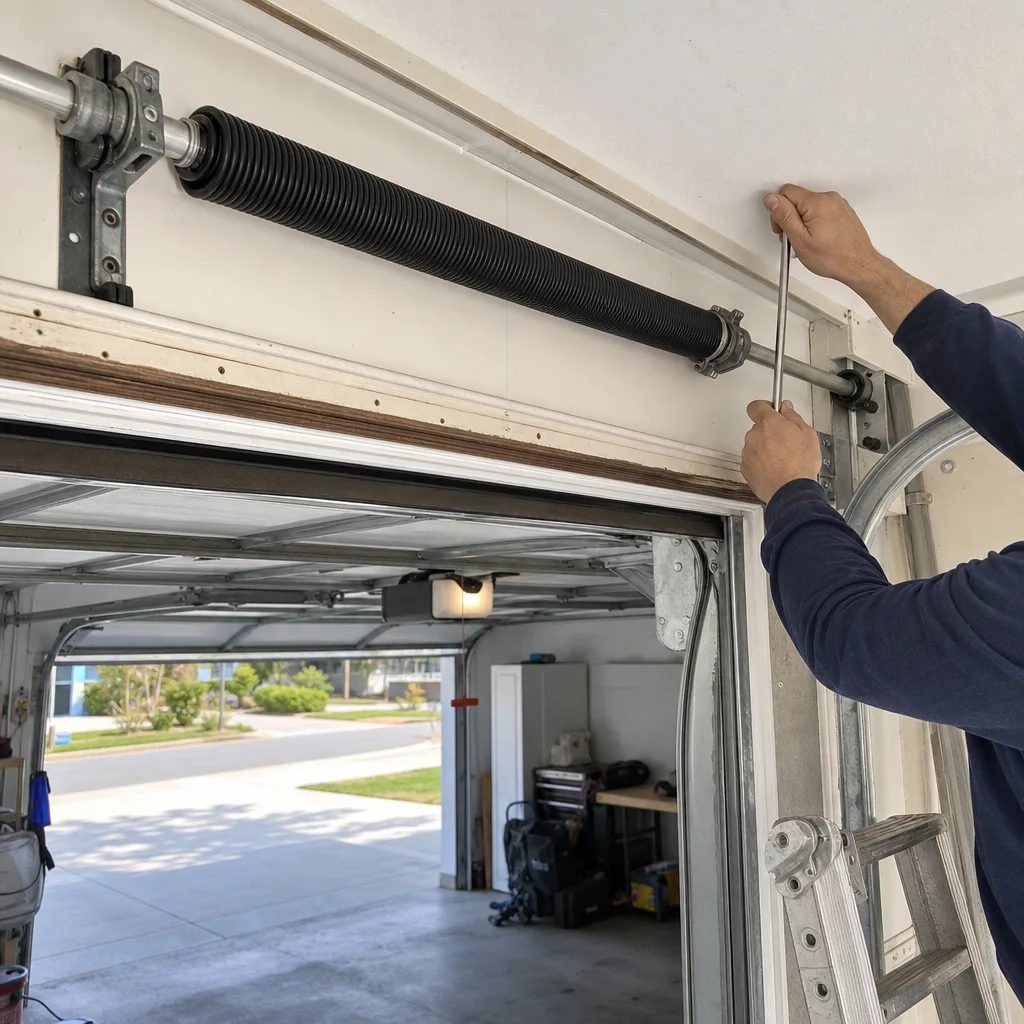
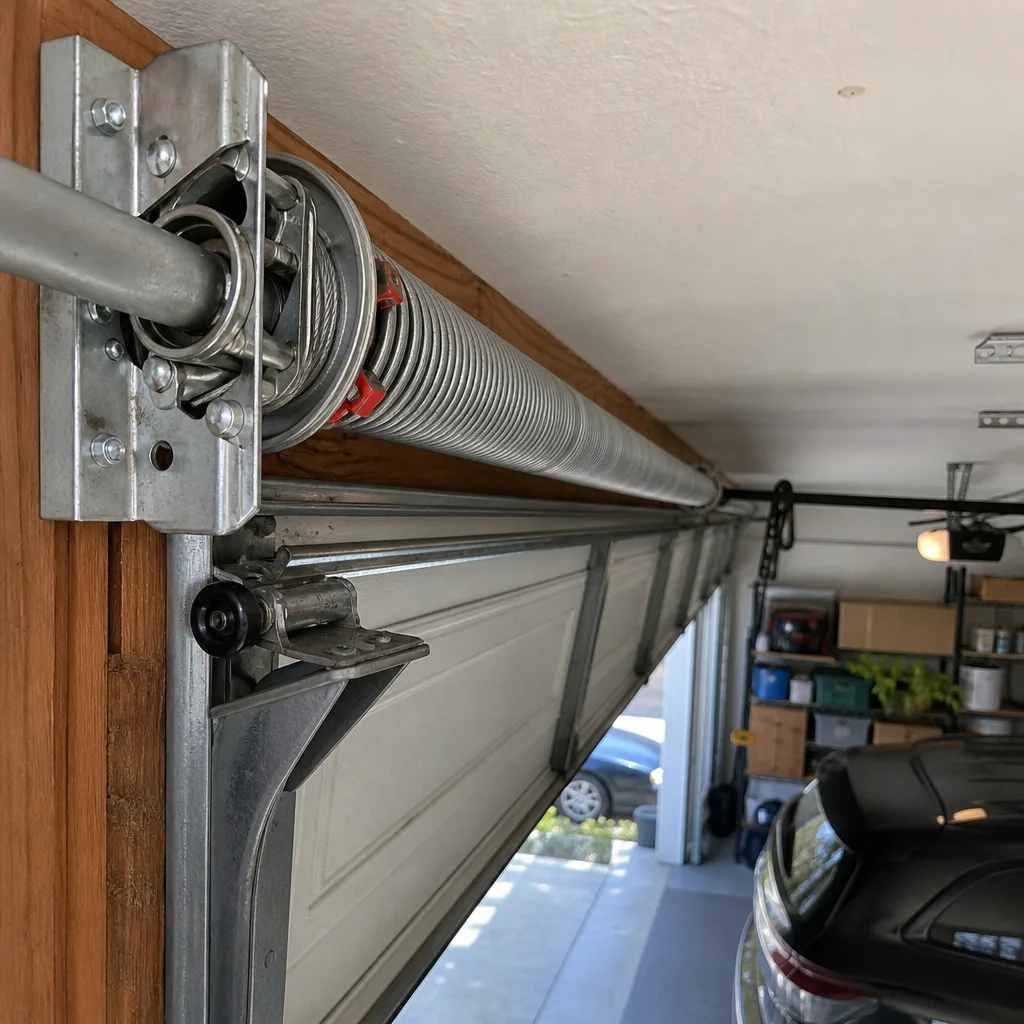
- Torsion spring coating: Look for white or gray powdery deposits on the spring body. These are salt crystals beginning to break down the factory galvanization. A light oil film displaces salt and prevents the corrosion cell from forming.
- Top rail and flag bracket: The horizontal rail above the door opening collects salt-laden condensation that drips onto the opener carriage. Check for rust streaking on the rail surface.
- Bottom fixtures and rollers: Salt spray from driveway runoff splashes upward. Steel rollers show pitting first. Nylon rollers degrade more slowly but can develop flat spots from salt-grit abrasion.
- Emergency release rope: Often overlooked. The red handle and nylon rope absorb moisture and salt, then stiffen and fray. Replacement is inexpensive; failure during a power outage is not.
What Professional Service Adds
Our $89 Seasonal Tune-Up includes a full hardware assessment with corrosion-inhibiting treatment of all steel components. We apply a light machine oil film to springs and hardware that displaces existing salt deposits without attracting dust. For homes within a half-mile of the harbor, we also inspect the door bottom seal for salt crystallization that accelerates rubber degradation. The garage door repair in Newport Beach calls we field in July are overwhelmingly from homeowners who skipped this window.
Late-Summer Heat Peak: Spring Tension Drift
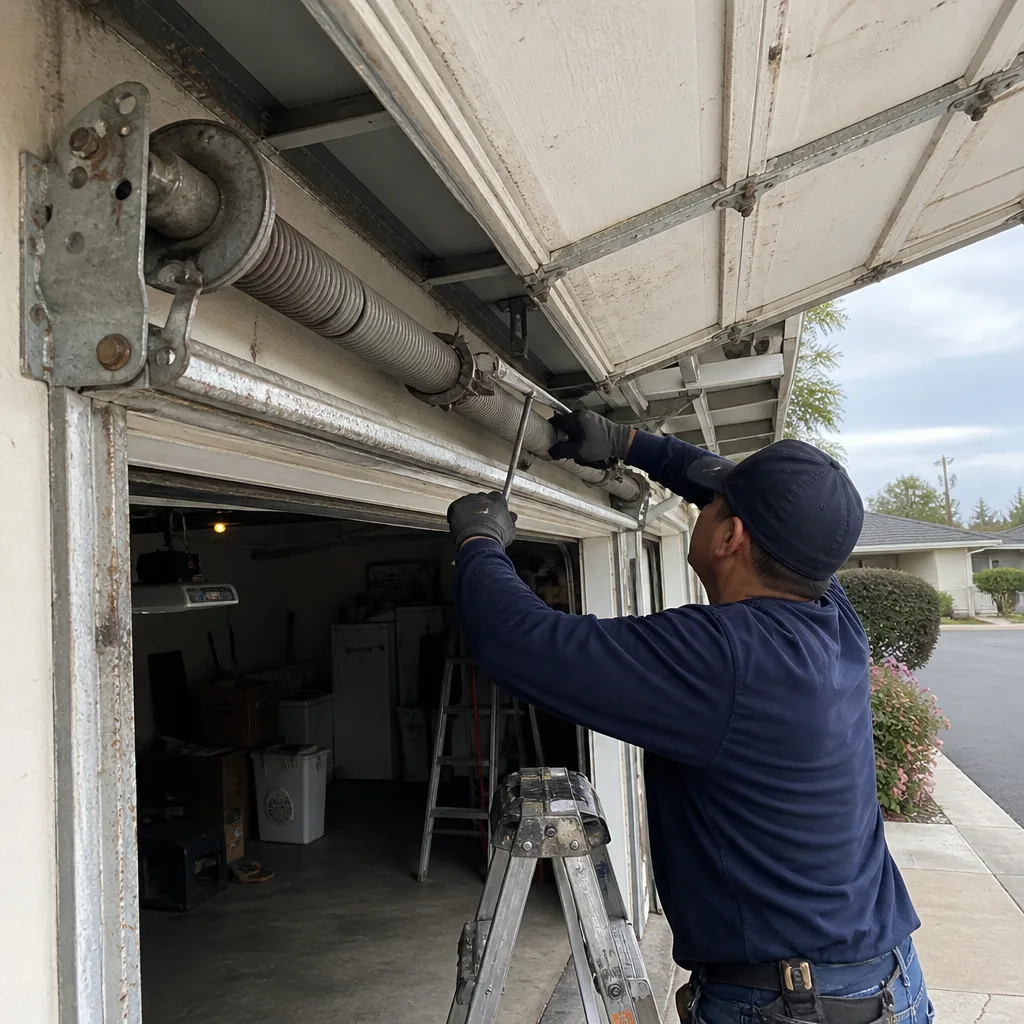
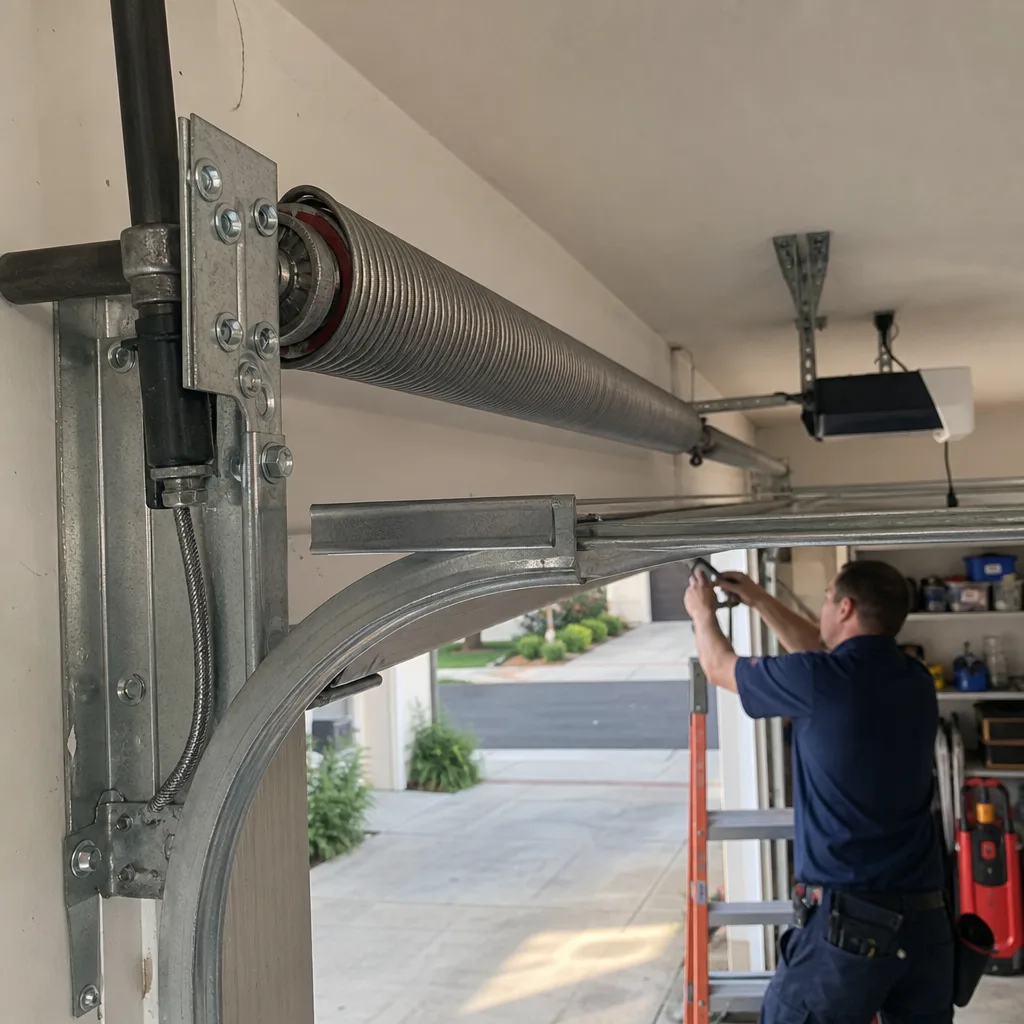
Steel torsion springs are calibrated to a specific number of turns at a specific temperature. In Newport Beach, the late-summer heat peak pushes garage interior temperatures to 95-105 degrees Fahrenheit in uninsulated garages, particularly those facing west or southwest. At these temperatures, the spring steel expands slightly, reducing effective tension. The door feels heavier. The opener works harder. The cycle life of both components shortens.
More critically, the differential heating between the interior and exterior of a spring creates micro-stress fractures. We’ve replaced springs in the Dover Shores and East Bluff neighborhoods that showed heat-fatigue failure patterns distinct from normal wear - the fracture surface shows a cup-and-cone shape indicating thermal cycling rather than simple cycle exhaustion.
Inspection Protocol for Late August
- Balance test with the door closed: Disconnect the opener. Lift the door manually to waist height. A properly balanced door stays in place. A door that drifts down has lost spring tension. A door that rises has excessive tension - also a problem, as it strains the opener on descent.
- Listen for opener strain: During normal operation, a belt-drive LiftMaster should run nearly silently. Chain-drive Craftsman units have more mechanical noise, but any new grinding or labored motor sound indicates the door is out of balance.
- Check lubrication condition: Heat breaks down lithium-based greases. The lubricant becomes thin and migrates away from bearing surfaces. Look for dark streaks on the door panels where grease has flung off the rollers.
- Inspect spring anchor bracket: The bracket securing the torsion spring to the header wall is under maximum load during heat expansion. Look for wall anchor loosening or bracket deformation.
Safety note: Torsion springs store enough energy to cause serious injury or death. Do not attempt to adjust spring tension. The balance test above is diagnostic only. If the door fails, call a professional.
The garage door installation in Newport Beach standards we follow include high-cycle springs rated for the thermal environment. If your springs are more than seven years old and your garage faces west, have them inspected before the heat peak.
Santa Ana Wind Season: Mechanical Overwork
The Santa Ana winds represent the highest-risk period for catastrophic garage door failure in Newport Beach. Sustained winds of 25-40 mph with gusts to 60 mph create a pressure differential across the door surface that the operating system was never designed to manage. A closed door in a wind event acts like a sail. The tracks absorb lateral loads they were engineered to resist only in the vertical plane.
We’ve responded to emergency calls in Big Canyon and Newport Coast where Santa Ana winds have forced a door out of its vertical tracks, leaving the home exposed and the door hanging precariously. These calls cluster in November and December, always after a multi-day wind event.
Pre-Season Inspection Points
- Track mounting bracket integrity: The brackets attaching vertical tracks to the door jamb are the failure point. Check for loose lag screws, stripped wood at the attachment point, or bracket deformation from previous wind loading.
- Horizontal track alignment: The radius where vertical meets horizontal track must be smooth. Any step or misalignment causes the roller to bind under lateral load, transferring force to the track itself.
- Weather seal compression: The bottom seal and perimeter seals must make full contact when closed. Gaps allow wind pressure to enter the garage, creating internal pressure that fights the door’s closing force. A door that doesn’t seal fully is a door that will fail in a Santa Ana event.
- Opener force settings: Auto-reverse sensitivity must be tested. Wind pressure can trigger false reversal if sensitivity is set too high, or prevent reversal on obstruction if set too low. The test is simple: place a 2×4 flat on the floor in the door path. The door should reverse on contact. If it doesn’t, the force setting requires adjustment.
During Wind Events
If Santa Ana winds are forecast, verify your door is fully closed and the opener is engaged. A partially open door is a failure waiting to happen. If you have a Wayne Dalton TorqueMaster spring system, the enclosed spring design offers some protection against wind-induced spring failure, but the track hardware remains vulnerable. Our technicians carry garage door opener in Newport Beach wind-load-rated replacement units for homes in exposed locations.
Winter Rain Intrusion: Seal and Drainage
Newport Beach receives 12-14 inches of annual rainfall, concentrated in February through April Pacific storm systems. The rain itself is not the primary problem. The problem is wind-driven water at the door perimeter, combined with homeowners who don’t inspect until they notice water inside the garage.
By the time water is visible, the damage is done. The bottom seal has compressed and lost resilience. The track drainage holes are clogged with accumulated dust from Santa Ana season. The door bottom itself may have absorbed moisture and begun delaminating, particularly on older wood or composite-panel doors.
February Inspection Checklist
- Bottom seal resilience test: Close the door on a sheet of paper. Pull the paper. It should drag with noticeable resistance. If it slides freely, the seal has compressed and needs replacement.
- Track drainage verification: The vertical track has drainage slots at the bottom. These clog with debris. Clear them with a wire or compressed air. Water trapped in the track accelerates rust and freezes roller movement.
- Threshold seal condition: The vinyl or rubber threshold seal adhered to the concrete floor lifts at edges over time. Wind-driven rain enters at these lift points. Replace adhesive or seal as needed.
- Panel bottom edge inspection: On wood doors, probe the bottom edge with a screwdriver. Soft wood indicates moisture absorption. On steel doors, check for rust blistering at the bottom hem. On composite doors, look for swelling or edge separation.
In the lower-lying areas near the Back Bay, we also check for tidal surge backup through floor drains. It’s uncommon, but a garage that floods once will have recurring door hardware corrosion for years.
UV Damage at Newport Beach Latitude
Newport Beach sits closer to the equator than most homeowners realize. At 33.6 degrees north, we receive approximately 15% more annual UV radiation than Los Angeles and 25% more than San Francisco. This difference is not trivial for garage door finishes.
Wood doors, particularly those with factory stain or paint, show UV degradation in 3-4 years without maintenance. The south and west exposures fail first. We’ve replaced panels in Harbor Ridge and Spyglass Hill where the interior face of the door remained pristine while the exterior had grayed, checked, and begun delaminating.
Composite and fiberglass doors fare better but are not immune. The gel coat on fiberglass doors chalks and thins. Factory-painted steel doors hold up longest, but the paint film degrades and the substrate begins rusting at scratches and panel edges.
Maintenance Interval That Prevents Replacement
For wood doors: Inspect finish annually, re-stain or repaint every 3-4 years on exposed elevations. For factory-finished steel: Touch up scratches immediately with factory-matched paint. For composite/fiberglass: Apply UV-protective automotive wax annually. The cost of this maintenance is negligible against the $1,200-$3,500 cost of panel or door replacement.
Our Mainspring Garage Door Co. home page includes a finish care guide for specific door materials. The key point: UV damage in Newport Beach is faster than the manufacturer’s national guidance suggests. Adjust your maintenance interval downward.
The One Annual Task Most Checklists Omit
Cable tension equalization is the single most overlooked maintenance procedure in garage door service. It is not intuitive. It is not visible. It is not mentioned in most DIY guides. And it extends the service life of drums, cables, and bottom fixtures by years.
Here’s what happens. Over thousands of cycles, the lift cables on either side of the door stretch microscopically at different rates. The left cable may be fractionally longer than the right. The door begins to rise slightly crooked. The rollers bind in the tracks on one side. The drums wear unevenly. Eventually, a cable jumps the drum or a bottom fixture cracks from the accumulated side load.
In Newport Beach, the salt and humidity environment accelerates cable corrosion, which accelerates stretch differential. We’ve found cables in harbor-area homes with 3/8-inch length difference that the homeowner never noticed because the door still operated.
The Equalization Procedure
This requires a professional. The door must be opened to the release position, cables detached from bottom fixtures, tension verified with a cable tension gauge, and adjusted to match within specification. The drums must be inspected for groove wear that would cause re-differential stretching. The procedure takes 30-45 minutes and is included in our annual tune-up service.
We recommend this be done in October, before Santa Ana wind season. A door with equalized cable tension tracks straighter under wind load and places less strain on the opener. The cost of prevention is the $89 tune-up. The cost of a cable-off-drum emergency call is $250-$400, often at inconvenient hours.
What You Can Check vs. What Requires a Pro
We’re straightforward about this. Some seasonal maintenance is appropriate for a careful homeowner. Some is not, for safety and technical reasons.
Homeowner-Appropriate Checks
- Visual inspection of springs, cables, and hardware for rust, fraying, or deformation
- Balance test (disconnect opener, lift manually to waist height, verify neutral position)
- Auto-reverse test with 2×4 board
- Weather seal and threshold inspection
- Photo-eye alignment and cleaning
- Lubrication of hinges and rollers with silicone or lithium spray (not WD-40 - it attracts dust)
Professional-Only Work
- Spring tension adjustment or replacement
- Cable tension equalization
- Track realignment or bracket reinforcement
- Opener force limit programming
- Panel structural repair or replacement
- Wind-load retrofit for exposed locations
The garage door repair in Newport Beach calls we prefer are the scheduled ones. The emergency calls, often at night or in weather, are the ones that could have been prevented. We’re available for both - our phones are answered by a live person 24/7, including holidays - but we’d rather see you on a Tuesday in June than a Saturday night in November.
Common Mistakes to Avoid
- Waiting for noise before acting: A noisy garage door is already damaged. The grinding you hear is metal-on-metal contact that has destroyed the lubricant film. By the time noise is audible, rollers, bearings, or the opener gear set may need replacement rather than maintenance.
- Using the wrong lubricant: WD-40 is a solvent, not a lubricant. It displaces water temporarily, then evaporates and leaves a sticky residue that collects dust and grit. In Newport Beach’s dusty Santa Ana season, this accelerates wear. Use lithium grease or silicone spray formulated for garage door components.
- Ignoring the marine layer: Homeowners in Corona del Mar and Balboa treat June Gloom as pleasant weather. It is, for people. For garage door hardware, it is the most corrosive period of the year. Inspect in early June, not mid-July when problems surface.
- Testing auto-reverse with your hand: The auto-reverse test should use a solid object like a 2×4, not your hand or foot. If the force setting is misadjusted, injury is immediate and serious. We still encounter homeowners who test with their hand because “it’s faster.”
- Replacing only one spring: Torsion springs are installed in matched pairs. If one fails, the other has the same cycle count and fatigue history. Replacing one guarantees a second service call within months. We replace both, with the same specification, every time.
- Assuming new doors need no maintenance: A new door from Clopay, Amarr, or Raynor is precisely adjusted at installation. It still requires seasonal inspection and lubrication. The warranty does not cover neglect.
- Blocking the photo-eye to “fix” a reversing door: If your door reverses before closing, the photo-eyes may be misaligned or dirty. Blocking or bypassing them creates a crushing hazard. The fix is alignment, not defeat.
When to Call a Professional
Call a professional when you observe any of the following: a door that won’t stay open or closed without opener assistance, visible spring gaps or separation, frayed or kinked cables, tracks that appear bent or separated from the wall, or an opener that runs but the door doesn’t move. These are not maintenance items. They are failure indicators that require immediate attention.
We also recommend professional inspection before any major weather event if your door is over ten years old, if your home is in an exposed location such as Newport Coast or the Peninsula, or if you’ve never had seasonal maintenance performed. Mainspring Garage Door Co. offers free estimates in Newport Beach - call (949) 325-2601. Our technicians arrive with springs, cables, openers, and hardware on the truck, so most jobs are completed in a single visit. The price is stated before any work begins. There are no surprises on the bill.
Frequently Asked Questions
Our seasonal tune-up is $89 and includes full hardware inspection, lubrication, balance test, auto-reverse verification, safety check, and cable tension assessment. Repairs identified during tune-up are quoted separately with the price agreed before work starts. Call (949) 325-2601 to schedule - estimates are free.
At minimum, once annually, ideally in October before Santa Ana wind season. For homes within a half-mile of the harbor or with west/southwest exposure, we recommend twice-yearly service: early June for salt deposit treatment and October for wind-season preparation. The $89 tune-up cost is unchanged for either visit.
Homeowners can apply spray lubricant to hinges, rollers, and the opener chain or screw. Do not lubricate the track surface - this causes roller slippage and attracts debris. Do not attempt to lubricate torsion springs; the procedure requires releasing tension and carries serious injury risk. Professional lubrication includes corrosion-inhibiting treatment of springs and hardware that consumer products don’t provide.
Santa Ana winds are dry, sustained, and directional. A Pacific storm has gusts and variable direction; the door absorbs and releases load. Santa Ana winds blow steadily from one direction for hours or days, creating resonant loading that fatigues track brackets and opener mounts. The dust and debris also contaminate lubricated surfaces, increasing friction. Pre-season inspection of track mounting and seal integrity prevents most wind-related failures.
No. Our flat price is stated before any work begins. If inspection reveals additional issues, we quote them separately and you approve before we proceed. There are no surprises on the bill. This is our standard practice, in writing on every job, backed by our 90-Day Done Right Promise.
Yes. Our trucks are stocked with springs, cables, rollers, hinges, openers, and hardware for LiftMaster, Chamberlain, Genie, Clopay, Amarr, Wayne Dalton, Craftsman, and Raynor systems. Most repairs are completed in a single visit. If your door or opener is an unusual model or discontinued, we source parts within 24 hours and schedule return installation.
The Bottom Line
Newport Beach’s garage doors face four distinct stress windows that don’t align with a generic maintenance calendar. The marine layer deposits salt in June. The late-summer heat drags spring tension. Santa Ana winds punish tracks and seals from October through January. Winter rain finds every gap the winds created. Understanding these windows lets you inspect the right components at the right time, turning reactive emergency calls into scheduled, inexpensive maintenance.
The annual procedures that matter most: early June salt inspection, late August balance verification, October track and seal reinforcement, February drainage and seal replacement, and the cable tension equalization that most homeowners never consider. Do these, and your door will outlast the neighborhood average by years. Skip them, and you’ll likely meet us on a Saturday night, which we’re happy for but you’d prefer to avoid.
Call (949) 325-2601 for a free estimate or to schedule your $89 Seasonal Tune-Up. Our phones are answered by a live person 24/7, including nights, weekends, and holidays. We arrive with the parts on the truck, state the price before the work starts, and stand behind every job with our 90-Day Done Right Promise in writing. That’s been our way since 1984.
Written by Carl Dutton, Owner at Mainspring Garage Door Co., serving Newport Beach since 2016.