
Last updated September 10, 2026
Full 25-point door and opener safety check with every visit - springs, cables, rollers, tracks, and your LiftMaster or Chamberlain opener included
You get a price before we start. It does not change when the truck arrives.

 Before
 After
After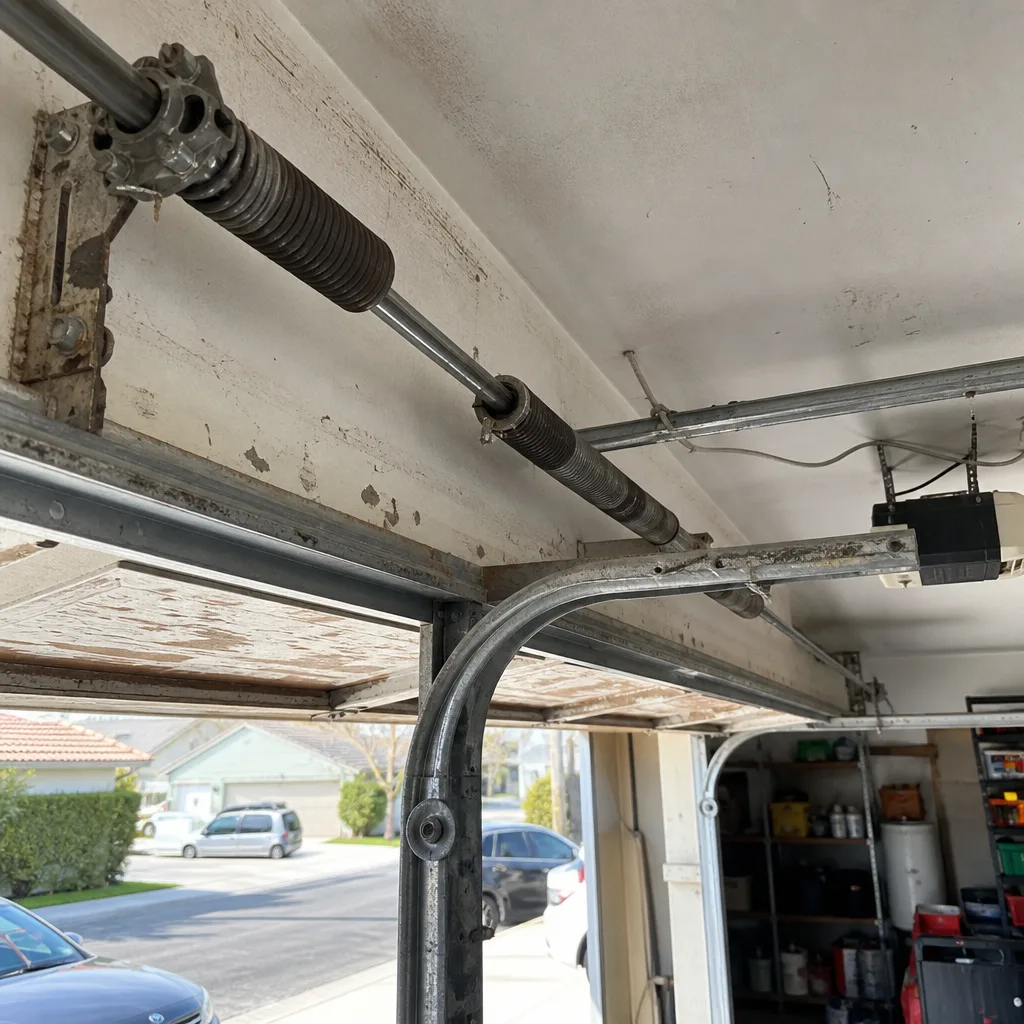 Before
 After
After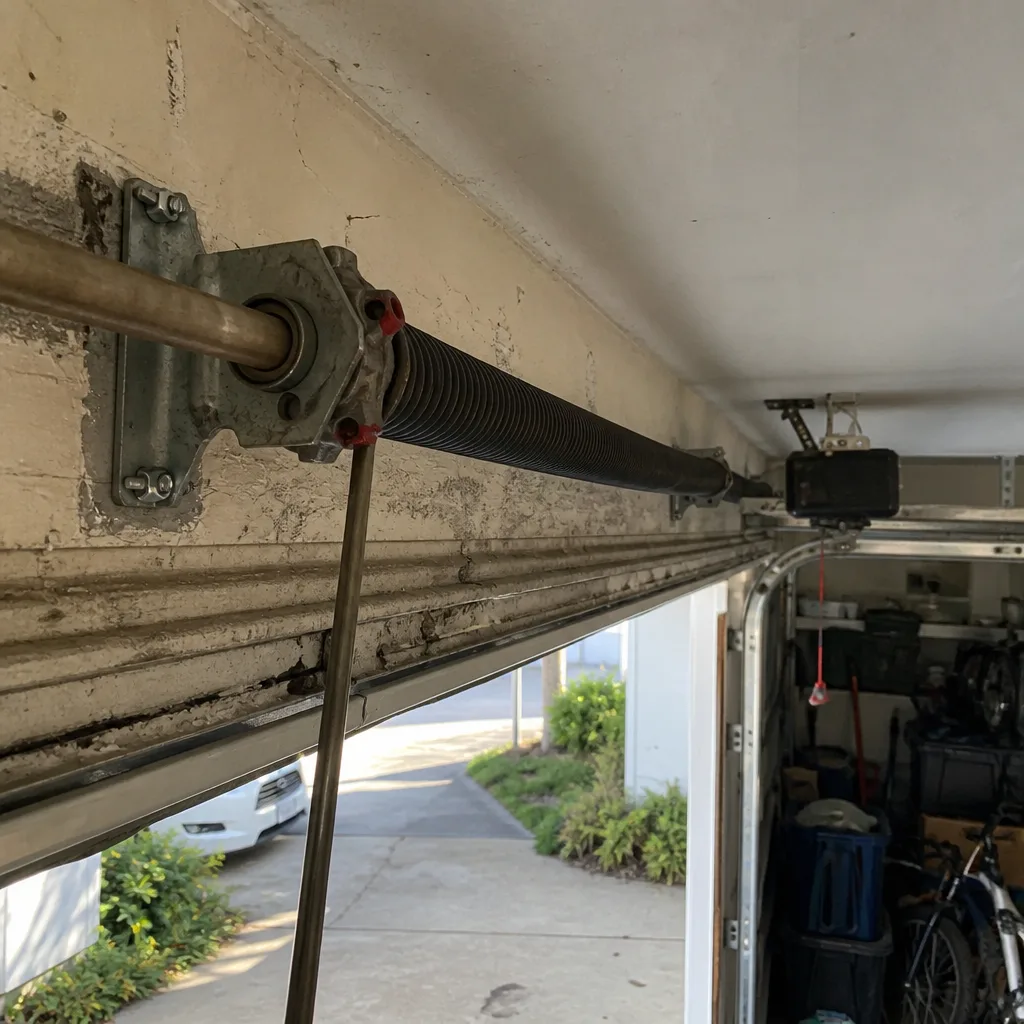 Before
 After
AfterGarage Door Repair Maintenance Checklist for Newport Beach Homeowners
The number-one cause of emergency garage door calls in coastal Southern California isn’t age. It’s an un-lubricated roller bearing that seized during a Santa Ana wind event when the door cycled thirty times in a single afternoon. Newport Beach homeowners face a unique combination of marine layer moisture, salt air corrosion, and seasonal wind stress that inland checklists simply don’t address. This guide organizes maintenance by how coastal conditions actually break hardware, not by arbitrary calendar months. You’ll learn which tasks protect against salt-air failure, which lubricants survive our climate, and exactly where your own inspection should end and a licensed technician’s work should begin.
Quick Answer
Garage door maintenance in Newport Beach requires quarterly inspection of salt-exposed hardware, semi-annual lubrication with marine-grade silicone or lithium complex grease, monthly auto-reverse testing, and annual weatherstripping replacement. Most emergency failures we see in coastal Orange County are preventable with this schedule, particularly roller seizure and spring corrosion that standard maintenance guides miss entirely. For deeper reading, see our Garage Door Warning Signs: A Newport Beach Homeowner’s Reference Guide.
Table of Contents
- How Coastal Conditions Destroy Garage Door Components
- The Visual Inspection Sequence: Catching Corrosion Six Months Early
- Lubrication Guide: Why Standard Grease Fails in Salt Air
- Safety Checks California Homeowners Cannot Skip
- Component-by-Component Maintenance Checklist
- The DIY Boundary: What You Can Handle and What Requires a Licensed Technician
- Common Mistakes to Avoid
- When to Call a Professional
- Frequently Asked Questions
- The Bottom Line
How Coastal Conditions Destroy Garage Door Components
Newport Beach sits at a convergence of environmental stressors that accelerate garage door wear in predictable patterns. Understanding these patterns is the foundation of effective maintenance here.
The marine layer rolls in most mornings from May through October, depositing microscopic salt crystals on every exposed metal surface. These crystals don’t simply sit there. They attract atmospheric moisture, creating an electrolyte film that completes the circuit for galvanic corrosion. In neighborhoods west of Jamboree Road, where the layer lingers longest, we’ve seen torsion springs show visible rust pitting in as little as eighteen months. East of the 73, where the hills block some marine influence, the same spring hardware typically lasts four to five years.
The Santa Ana winds arrive as the counterpunch. These hot, dry easterlies strip away protective lubricant films and force doors to cycle repeatedly as homeowners shuttle cars, patio furniture, and trash bins indoors. A door that normally opens four times daily can see thirty cycles in a single Santa Ana afternoon. Each cycle wears rollers, flexes cables, and fatigues springs. Without proper lubrication, the friction heat from these marathon sessions accelerates wear exponentially.
Then there’s the temperature swing itself. Morning marine layer temperatures in the fifties give way to afternoon sun in the eighties, causing thermal expansion and contraction in steel tracks and aluminum door panels. This daily flexing loosens fasteners and gradually throws door alignment out of specification.
The components fail in a recognizable sequence:
- Roller bearings seize first, typically twelve to eighteen months after installation if lubricated with standard white lithium grease. The salt crystals penetrate the bearing seal, the grease emulsifies with condensed moisture, and the bearing races corrode.
- Bottom brackets and cable drums develop corrosion at the cable contact points, creating rough surfaces that fray cables from the inside out.
- Torsion springs corrode from the outside in, with pitting creating stress risers that lead to sudden catastrophic failure.
- Weatherstripping hardens and cracks from UV exposure combined with salt spray, losing its seal and allowing more corrosive air into the garage environment.
- Opener rail and chain accumulate gritty salt residue that increases motor load and wears drive components prematurely.
This failure sequence is why we organize maintenance by component stress, not by season. A Newport Beach door needs roller attention before spring attention, and weatherstripping replacement before either if the seal has already failed.
The Visual Inspection Sequence: Catching Corrosion Six Months Early
A proper visual inspection takes twelve minutes and requires only a flashlight, a step ladder, and knowing exactly where to look. We teach this sequence to every Newport Beach homeowner who asks, because catching corrosion at the staining stage prevents the emergency call six months later.
Step 1: Track and roller examination (3 minutes)
With the door closed, shine your flashlight up the vertical track on each side. Look for orange-brown staining where the roller stem enters the bracket. This is the first visible sign of salt intrusion into the bearing. The roller wheel itself may still spin freely, but the bearing is already compromised. In Corona del Mar homes within two blocks of the water, we find this staining on roughly sixty percent of doors older than two years.
Check the track interior for black streaks or grease that has turned gray and watery. Healthy lubricant is translucent amber or clean white. Gray emulsion means moisture contamination.
Step 2: Spring and cable survey (4 minutes)
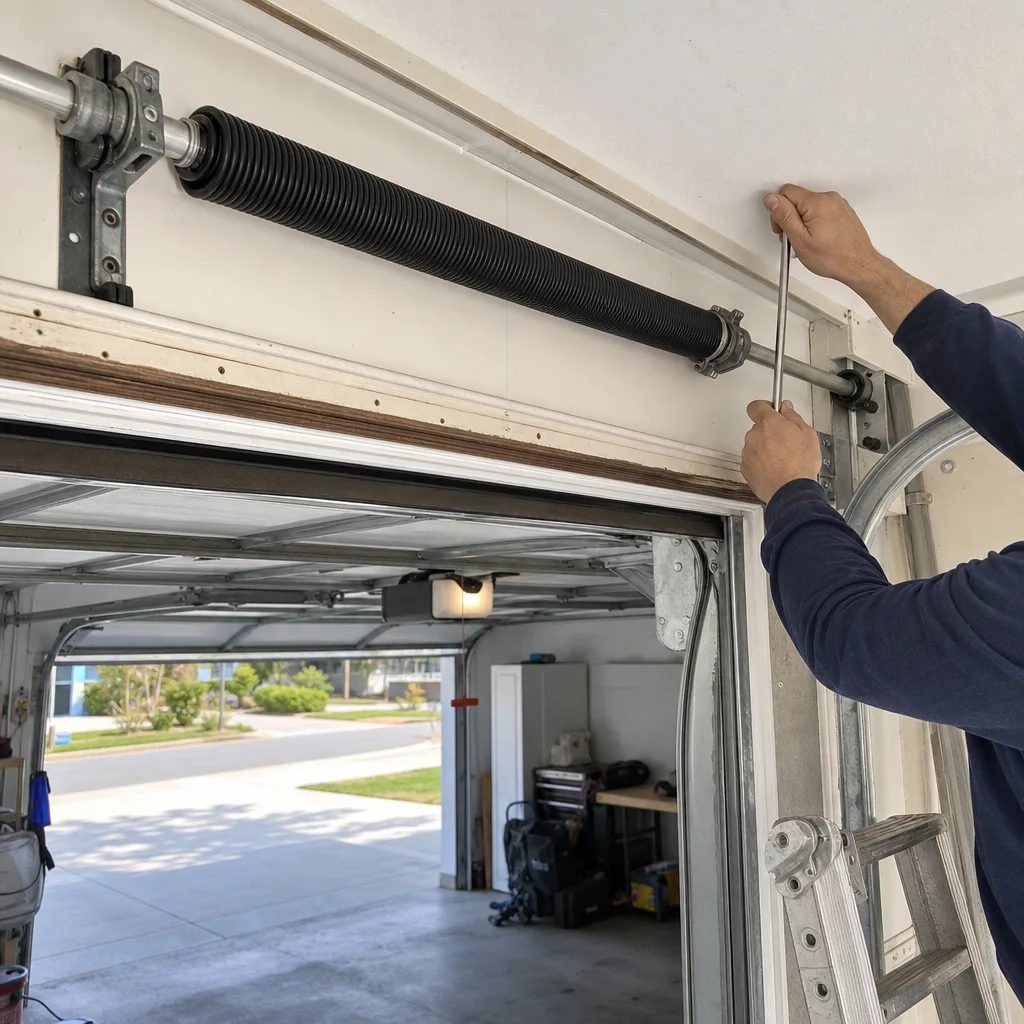
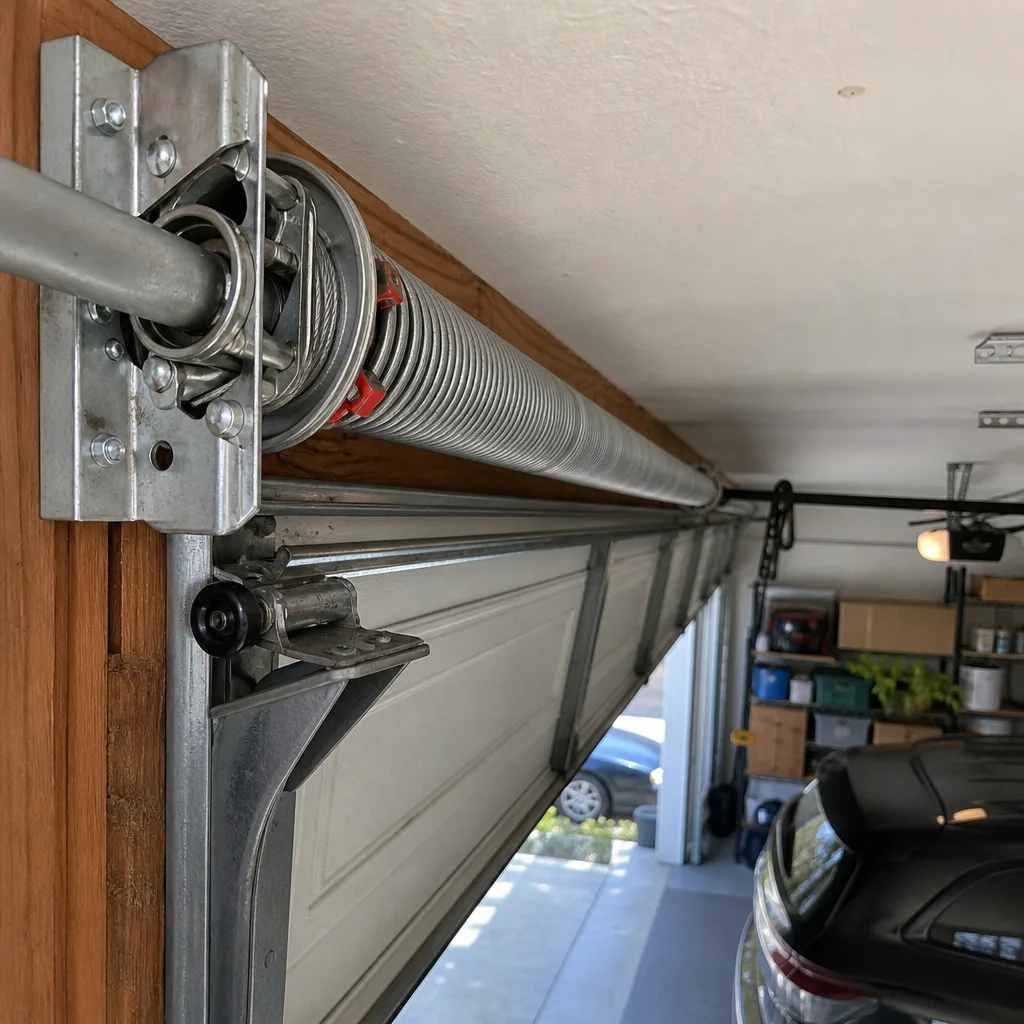
Stand inside the garage with the door closed. The torsion spring is the coiled steel tube above the door header. Examine it with your flashlight for any orange discoloration, pitting, or flaking. Run your finger lightly along the bottom surface where condensation collects. A slight roughness means pitting has begun. Deep scoring or visible rust flakes means replacement should be scheduled within the month.
Follow each lift cable from the bottom bracket up to the drum. Look for fraying, kinking, or any point where individual wires have separated from the strand. Pay particular attention to the cable’s path over the drum, where salt corrosion roughens the surface and accelerates wear. A single broken wire in a cable strand is sufficient reason to replace the cable entirely.
Step 3: Hardware and fastener check (3 minutes)
Examine all bolts and lag screws for rust staining around the heads. In coastal environments, fasteners loosen as corrosion products expand beneath the head, then loosen further from vibration. Tighten any bolt that turns with moderate hand pressure on a socket wrench, but do not overtighten. Stripped threads in aluminum door components are a costly mistake.
Check the hinges between door sections for cracks, particularly at the bolt holes. The thermal cycling in Newport Beach creates more hinge stress than inland climates, and cracked hinges are the primary cause of door panel misalignment.
Step 4: Seal and threshold inspection (2 minutes)
Close the door and examine the bottom seal from outside. It should present a continuous, slightly flexible edge. Any cracking, hardening, or gaps where light shows through means the seal has failed. Failed seals admit salt air, sand, and moisture that accelerate corrosion of everything inside the garage, including the door itself.
Check the vinyl or rubber seal along the door’s sides and top. UV degradation shows as surface cracking or a chalky residue when rubbed.
Document what you find. A phone photo of each concern creates a record for comparison at your next inspection and gives any technician you call a clear picture of what they’re addressing. You can also explore more guides & resources on our blog to sharpen your inspection skills.
Lubrication Guide: Why Standard Grease Fails in Salt Air
The lubricant question generates more confused phone calls than any other maintenance topic. Homeowners read a generic checklist, buy white lithium grease at the hardware store, apply it faithfully, and still see premature failure. The problem isn’t their diligence. It’s the product specification.
Standard white lithium grease, the default recommendation in most maintenance guides, contains soap thickeners that emulsify with moisture. In Newport Beach’s marine layer environment, this emulsification happens within weeks, not months. The grease turns gray, then washes out of the bearing entirely, leaving metal-on-metal contact protected by nothing.
We’ve tested lubricant performance on coastal garage doors for four decades. The products that survive here share specific characteristics:
| Lubricant Type | Best Application | Why It Works in Salt Air | Reapplication Interval |
|---|---|---|---|
| Silicone spray (dry film) | Tracks, rollers, hinges | Does not attract dust or emulsify with moisture; leaves non-stick film | 4-6 months |
| Lithium complex grease (NLGI #2) | Torsion spring coils, screw drive opener rails | Superior water resistance vs. standard lithium; higher drop point for Santa Ana heat | 6 months |
| Penetrating oil with corrosion inhibitor | Cable contact points, bottom brackets | Wicks into crevices, displaces moisture, leaves protective film | 3 months |
The application technique matters as much as the product. For roller bearings, spray silicone directly into the bearing gap where the stem meets the wheel, then cycle the door twice to distribute. For torsion springs, apply lithium complex grease sparingly to the coil faces where they touch during winding. Excess grease attracts airborne salt and grit, creating an abrasive paste.
Never use WD-40 as a lubricant on garage door components. It is a water displacer and light solvent, not a lubricant, and its residue evaporates within days. We see doors in Newport Beach withWD-40 residue that attracted salt crystals and accelerated corrosion beyond what no lubricant would have caused.
For homeowners in harbor-adjacent neighborhoods like Lido Isle or Balboa Peninsula, we recommend stepping up to marine-grade corrosion inhibitor sprays marketed for boat trailer bearings. These products are formulated specifically for salt-air immersion and provide the longest protection interval we’ve measured in coastal conditions.
Safety Checks California Homeowners Cannot Skip
California Building Code Section 3109.4 requires all automatic garage door operators manufactured after 1993 to include both automatic reverse and constant pressure controls. The code is specific. The testing is simple. The consequences of neglect are severe.
Monthly auto-reverse test
- Place a 2×4 board flat on the floor, centered under the door path.
- Close the door using the remote or wall button.
- The door must reverse direction within two seconds of contacting the board and return to fully open.
- If the door stops but does not reverse, or if it continues downward with pressure on the board, the opener force setting requires immediate adjustment.
Monthly photo-eye test
- Start the door closing.
- Sweep a broom handle through the beam path between the two photo-eye sensors, mounted 4-6 inches above floor level on each side track.
- The door must reverse immediately.
- Clean the sensor lenses with a soft cloth if response is delayed.
- Check sensor alignment if the door fails to reverse; the LED indicators on most units show solid when aligned and blinking when disturbed.
Force sensitivity verification
This is the check most homeowners skip, and it’s the one that prevents injury. With the door fully open, grasp the bottom edge and attempt to stop the door’s downward movement by hand. Apply steady, moderate resistance. The door should reverse immediately. If you can hold the door against its motor for more than one second before reversal, the down-force setting is excessive and dangerous.
In Newport Beach, we see force settings drift high for two reasons. Salt corrosion in the track increases rolling resistance, which the opener’s force sensor interprets as normal load. Homeowners or previous technicians then increase force to compensate for sticky rollers rather than addressing the root cause. The result is an opener that will crush an obstruction rather than reverse.
Force adjustment is not a homeowner task. The adjustment screws or digital settings control stored energy that can cause sudden door movement. A qualified technician will clean and lubricate the system first, verify smooth operation, then set force to manufacturer specification with a calibrated approach. If you’re selecting a pro, our How to Hire a Garage Door Contractor in Newport Beach: A Step-by-Step Guide walks through the vetting process.
Manual release function
Test the red emergency release cord monthly. Pull it firmly to disengage the opener trolley, then lift the door manually. It should move smoothly and stay open at waist height without drifting. If the door is heavy or drifts down, the spring system is out of balance and requires professional service. A door that feels heavier than forty pounds to lift manually has a spring problem that will damage the opener if uncorrected.
Component-by-Component Maintenance Checklist
This checklist is organized by failure mode frequency in coastal Orange County, highest to lowest. Complete items in this order for maximum prevention value.
Roller Bearings and Hinges
Frequency: Inspect monthly, lubricate quarterly
Coastal factor: Highest failure rate in Newport Beach due to salt intrusion
- Spin each roller by hand with the door closed. It should rotate freely with no grinding or catching.
- Listen during door operation for squeaking or rumbling that indicates bearing degradation.
- Lubricate with silicone spray, working the door through two complete cycles after application.
- Replace any roller that does not spin freely after lubrication. Nylon rollers with sealed bearings outperform steel rollers in salt air and typically last 5-7 years versus 2-3 for unsealed steel.
- Check hinge bolts for tightness; replace any hinge with visible cracks at bolt holes.
Weatherstripping and Seals
Frequency: Inspect quarterly, replace annually if cracked
Coastal factor: UV and salt spray degradation accelerated by reflection off water and light-colored pavement
- Close door and examine bottom seal for continuity and flexibility.
- Check side and top seals for hardening, cracking, or detachment from retainer.
- Verify the threshold seal makes contact across the full door width; gaps admit sand that accelerates track wear.
- Replace with EPDM rubber or vinyl formulations rated for marine UV exposure, not standard automotive weatherstripping.
Torsion Springs and Lift Cables
Frequency: Inspect monthly, professional service only for adjustment or replacement
Coastal factor: Corrosion pitting creates stress risers; sudden failure without warning is common
- Visual inspection for rust, pitting, or coil separation as described in the inspection sequence above.
- Check cable tension with door fully closed; cables should be taut with equal tension on both sides.
- Look for cable fraying, kinking, or broken strands at attachment points.
- Never attempt to adjust spring tension, unwind a spring, or replace a cable. Torsion springs store lethal energy. Our technicians are trained under the K.E.Y.S. values code, and spring work is explicitly journeyman-level trade work.
Tracks and Alignment
Frequency: Inspect quarterly
Coastal factor: Thermal expansion from daily temperature swings loosens mounting hardware
- Verify tracks are plumb and parallel using a level; the gap between roller and track should be consistent top to bottom.
- Tighten lag screws at track mounting brackets if loose.
- Clean track interior of accumulated grease, salt residue, and debris with a cloth dampened in mineral spirits. Do not lubricate tracks; lubricant in tracks causes roller slippage and door misalignment.
- Check for dents or bends that could cause roller binding.
Opener Drive System
Frequency: Inspect semi-annually, lubricate per type
Coastal factor: Salt dust infiltration increases motor load and wears drive components
- Chain or belt drive: Check tension per manufacturer specification; lubricate chain with lithium complex grease, not oil.
- Screw drive: Apply manufacturer-recommended lubricant to full screw length annually.
- Direct drive: No lubrication required; inspect motor mount for secure attachment.
- Test battery backup function if equipped; replace battery every 2-3 years or per indicator.
- Verify safety label legibility and replace if faded.
Panel Condition and Hardware
Frequency: Inspect annually
Coastal factor: Aluminum and steel panels show salt corrosion at seams and edges; wood doors swell from marine layer moisture
- Steel doors: Check for rust at panel edges, window frames, and decorative hardware attachment points. Sand and touch up with rust-inhibiting primer and paint.
- Aluminum doors: Look for white powdery oxidation at seams; clean and apply automotive wax to protective anodized finish.
- Wood doors: Check for swelling, delamination, or rot at bottom panel edges; ensure drainage holes are clear.
- Fiberglass and composite: Inspect for UV chalking or surface cracks; clean with mild detergent.
The DIY Boundary: What You Can Handle and What Requires a Licensed Technician
We believe in homeowners understanding their doors. We also believe in being direct about where that understanding must stop and professional training must take over. The boundary is clear and non-negotiable.
Homeowner-appropriate tasks:
- Visual inspection of all components as described in this guide
- Lubrication of rollers, hinges, and opener chain with proper products
- Tightening of accessible fasteners with hand tools
- Weatherstripping replacement
- Photo-eye cleaning and alignment verification
- Manual release testing and basic opener programming
Licensed technician required:
- Any work involving torsion or extension springs, including visual assessment that suggests replacement is needed
- Cable replacement or tension adjustment
- Opener force setting adjustment
- Track realignment or replacement
- Bottom bracket replacement (these brackets are under cable tension)
- Any repair with the door in a partially open position where it could fall
The spring boundary deserves emphasis. Torsion springs are wound to store enough energy to lift a door weighing 150-400 pounds. That energy does not dissipate when the door is open or closed. A winding bar slipped from a cone, a cable released under tension, or a spring that breaks during handling can cause serious injury or death. In forty-two years, we’ve seen the aftermath of well-intentioned DIY spring work, and we will not describe the technique because we do not want it attempted.
Our technicians arrive with springs, cables, and hardware on the truck, so most jobs finish in a single visit. The flat price is stated before any work begins. This is the square deal that protects both the homeowner and the technician.
Common Mistakes to Avoid
- Using white lithium grease on coastal hardware. It emulsifies with marine layer moisture within weeks, leaving bearings unprotected. Switch to silicone spray or lithium complex grease formulated for water resistance.
- Lubricating the track interior. This causes roller slippage, door misalignment, and accumulation of salt-laden grit. Tracks should be clean and dry.
- Ignoring the bottom seal until water enters the garage. A failed seal admits salt air that corrodes springs, cables, and vehicles. Replace at first sign of hardening or cracking.
- Testing auto-reverse with a lightweight object. California code specifies a 2×4 board for a reason. A soft foam block won’t verify that force settings are safe for a pet or child.
- Delaying spring replacement until failure. A broken torsion spring often damages the door, bends tracks, or injures someone nearby. Schedule replacement at the first sign of pitting or coil separation.
- Using generic replacement rollers from big-box stores. These are typically unsealed steel rated for inland use. In Newport Beach, specify sealed-bearing nylon rollers or expect replacement within two years.
- Neglecting opener maintenance while focusing only on the door. Salt dust in the opener housing increases motor load and burns out logic boards. Annual opener inspection extends system life significantly.
When to Call a Professional
Call a licensed garage door technician when you observe any of the following: a door that feels heavy to lift manually, visible spring corrosion or coil separation, frayed or kinked cables, a door that hangs crooked or binds in the track, an opener that reverses inconsistently or fails safety tests, or any grinding, popping, or banging during operation. These symptoms indicate conditions that will worsen and become more expensive, or that present immediate safety risk.
Garage Door Repair in Newport Beach from Mainspring Garage Door Co. includes free estimates with upfront flat pricing, our 90-Day Done Right Promise in writing, and technicians who arrive with the parts to finish most jobs in a single visit. We’re factory-familiar with all major brands including Chamberlain, Genie, Clopay, and Amarr. Call (949) 325-2601 anytime - a live person answers, including nights, weekends, and holidays.
Frequently Asked Questions
Inspect monthly, lubricate quarterly, and schedule professional service annually. The marine layer and salt air here accelerate wear beyond what inland homeowners experience, so the standard “twice yearly” advice found in generic guides is insufficient for coastal Orange County. Our $89 Seasonal Tune-Up covers the professional inspection and adjustment that prevents emergency calls.
Use silicone spray with dry film technology on rollers, hinges, and tracks, or lithium complex grease (not standard white lithium) on springs and opener chains. Standard white lithium grease fails within weeks in salt air by emulsifying with moisture. For homes within two blocks of the water, marine-grade corrosion inhibitors formulated for boat trailer bearings provide the longest protection.
No. Torsion springs store lethal energy and require specialized training, winding bars, and safety procedures. This is not a homeowner task under any circumstances. A broken spring or slipped winding bar can cause serious injury or death. Our background-checked, uniformed technicians handle spring replacement with the door secured and energy controlled, and we back the work with our 90-Day Done Right Promise.
Mainspring Garage Door Co. offers a $89 Seasonal Tune-Up that includes full inspection, lubrication with marine-grade products, safety testing, and adjustment of all accessible components. Repairs identified during maintenance receive a flat price quote before any work begins, with $50 off any repair over $250. Seniors and veterans receive a permanent 5% discount. Call (949) 325-2601 for scheduling.
The marine layer is thickest November through March, and colder steel contracts slightly, increasing clearance tolerances in bearings and hinges. Combined with thickened residual grease, this creates the grinding or squeaking you hear. Quarterly lubrication prevents this seasonal noise increase, which is more pronounced in Newport Beach than inland due to our persistent winter moisture.
Close the door on a sunny day and look for light leaks at the bottom or sides. Feel for drafts with your hand. The seal material should be flexible and resilient; if it cracks when pinched, or if you see permanent compression set where the seal has flattened, replacement is due. In coastal neighborhoods, we recommend annual replacement of bottom seals and biennial replacement of side and top seals.
The Bottom Line
Garage door maintenance in Newport Beach is not a calendar exercise. It is a response to specific environmental stressors, marine layer moisture, salt air corrosion, Santa Ana wind cycling, and thermal expansion, that break components in a predictable sequence. The homeowner who inspects monthly, lubricates with marine-grade products quarterly, and respects the boundary between DIY care and professional spring work will avoid nearly every emergency call we receive. The ones we do receive are typically from doors that went two years without inspection, with a seized roller or corroded spring that gave no warning until failure.
We’ve been serving this community since 1984. The promise has not changed: the flat price before the wrench comes out, the part on the truck, the work finished in one visit, and the 90-Day Done Right Promise in writing. That’s the square deal. That’s Mainspring.
Questions about your door’s condition? Call (949) 325-2601 for a free estimate. A live person answers, and we’ll be there when we say.
Written by Carl Dutton, Owner at Mainspring Garage Door Co., serving Newport Beach since 2016.